+91 8178473475
info@iameya.in
Follow Us On :

Menu
How Biz Lazikill Task Management Helped Field Teams Stay Organised Across Multiple Locations
-
admin
- May 13, 2026
About the Client
A field staff management operation deploys on-site workers across multiple locations to carry out assigned site work. Each engagement involves assigning workers, tracking their on-site activity, recording resources used, and ensuring timely completion of tasks at every active site.
As the number of simultaneous site deployments grew, managing field operations from a central point became increasingly difficult. There was no structured system to record who was deployed to which site, what work was being carried out, how long it was taking, or whether workers were meeting the expected standard.
This created three compounding operational gaps that leadership could not address without a structured platform:
Managers could not verify site attendance or track task progress across any active deployment
Productivity data did not exist, making performance management entirely subjective
High-performing workers had no formal recognition mechanism, reducing motivation across the field team
Key Outcomes & Business Impact
100% Site Task Visibility
Every worker deployment now has a structured task record capturing assignment, site presence proof, resources used, and completion status — accessible to management in real time.
Verified Site Attendance
Photo upload within each task provides verifiable, timestamped proof that workers reached the site — eliminating attendance disputes and unverified field claims.
Productivity Now Measurable
Time tracking at task level gives managers objective data on how long each site task takes, whether it was delivered on time, and by how many days any delay occurred.
Zero Blind Spots in Team Performance
The Admin Dashboard and health score give managers a real-time read on every worker’s task status and delivery rate without a single manual follow-up.
Reward Decisions Based on Data
The Reward & Recognition module identifies top performers objectively and calculates appropriate rewards automatically based on manager-defined rules — removing all subjectivity.
Worker Motivation Increased
The visible leaderboard and transparent reward records create ongoing motivation across the field team, with high performers consistently acknowledged and rewarded.
Pain Points & Solutions
Before implementing the Biz Lazikill management system, the client encountered three core operational gaps that were directly impacting site task management, workforce productivity, and employee recognition:
PAIN POINT 01
Challenge :-
The company had no structured system to record which workers were assigned to which site, what tasks they were performing, how long they spent on site, or what resources were allocated to them. Site assignments existed only as verbal instructions. Managers had no way to verify whether workers had arrived at the site, what work had been completed, or what materials had been used. There was no audit trail for any field activity.
Solution :-
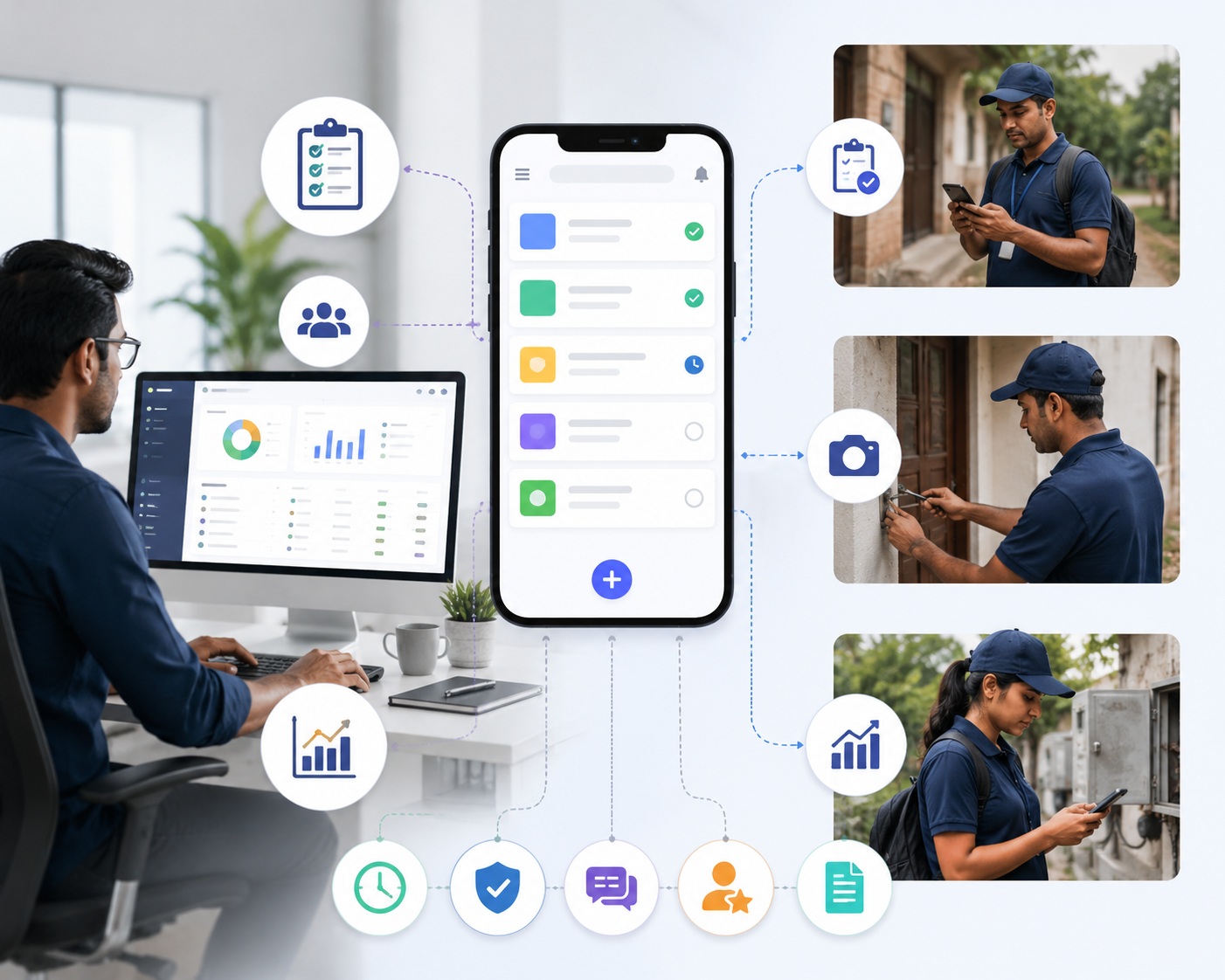
A dedicated Task module with an Assign to feature was deployed. Managers could now select and assign multiple workers to any site task. Each worker was required to upload a photograph via the document upload field as proof of site presence — creating a verifiable attendance record. The task form included a description field where resources issued and work completed were logged. Every site task was now fully documented from assignment through to completion, with a complete, timestamped audit trail.
PAIN POINT 02
Challenge :-
The Organisation had no mechanism to track worker productivity. There was no record of when a site task was started, when it was completed, or whether it had exceeded its due date. The company could not identify which workers were consistently delivering on time, which tasks were delayed and by how many days, or how workload was distributed across the field team. Performance evaluation was based entirely on subjective impression, with no data to support or challenge it.
Solution :-
A Time Tracking feature was deployed at the task level. The system began recording time automatically when a task was moved to In Progress and stopped when it was marked Complete. Created-on date, start date, and completion date were all logged against every task. The Admin Dashboard gave managers a real-time view of all worker tasks, their current statuses, time taken, and overdue indicators. A project health score was calculated dynamically based on task completion and delay rates across the team, giving management an objective, continuously updated read of operational performance.
PAIN POINT 03
Challenge :-
Workers who completed site tasks on time and to standard had no formal mechanism for recognition or reward. The company wanted to acknowledge top performers but had no system to identify them objectively, no structured process for offering rewards, and no visible record that would motivate others. High performance went unacknowledged, and there was no data to support reward decisions — making the process both inconsistent and entirely dependent on individual manager memory.
Solution :-
A Reward & Recognition module was deployed, integrated directly with the Admin Dashboard. A leaderboard displays the names of top-performing workers based on task completion rates and on-time delivery. A dedicated rules tab allowed managers to set reward criteria and associated amounts, and the system automatically calculated and suggested appropriate rewards for qualifying workers. Recognition records were maintained in the system and visible to the full team, creating ongoing motivation, transparent accountability, and a consistent, data-driven basis for every reward decision.
PAIN POINT 04
Challenge :-
Software development involves client meetings, internal reviews, task walkthroughs, and stand-ups that are linked to specific projects and tasks. The company had no structured way to schedule these activities, attach them to the relevant project, or ensure reminders reached the right people. Meetings were arranged through WhatsApp and personal calendars with no connection to the project record — context was lost, and there was no consolidated view of upcoming project-linked commitments.
Solution :-
An Activity Scheduling module was deployed. Team members now create activities of any type — meeting, call, note, to-do — attached directly to the relevant project or task, with a date, time, and optional document. The system sends an automated reminder 30 minutes before each activity. The consolidated Activity tab gives Project Managers a single screen showing all upcoming project-linked commitments across the team, all reminded automatically.
PAIN POINT 05
Challenge :-
Many software operations involve recurring work: weekly code reviews, monthly reporting, regular deployment checks, and scheduled client updates. The company had no mechanism to automate the recurrence of these tasks. Each occurrence had to be manually created — and when it was not, the task was simply missed. Recurring work reliability was entirely dependent on individual memory, which meant it was inconsistent by design.
Solution :-
A Repetitive Task module was deployed. When creating a task, users select the Repeated Task type, set the recurrence frequency (daily, weekly, or monthly), and define a stop date. The system automatically creates the next instance at the configured interval and notifies the assigned team member at the scheduled start time. No recurring task is missed because no one has to remember to create it — the system handles the recurrence, the team member handles the work.
PAIN POINT 06
Challenge :-
Tasks that could not be immediately assigned to a specific person — due to availability uncertainty, ownership ambiguity, or workload concerns — were noted informally. These informal records were frequently lost, misplaced, or forgotten. Tasks were duplicated, missed entirely, or picked up without the right context. There was no shared space where unassigned work could be made visible to the whole team and claimed by whoever had the capacity to take it on.
Solution :-
A Company Job Bucket module was deployed. Unassigned tasks are now created as Job Bucket tasks, visible to every team member in a shared view. Any team member with the capacity and context can claim a task — at which point it moves into their personal My Task portal and becomes their documented responsibility. No work is lost, forgotten, or duplicated. Unassigned tasks now have a structured home, a visible record, and a clear mechanism for being picked up by the right person.
Product Features
Biz Lazikill is a purpose-built Project & Task Management platform developed by Ameya Innovex, designed for organisations that coordinate field teams across multiple sites, track worker productivity, manage documents, and maintain clear accountability at every level. The features deployed for the client are as follows:
| Module / Feature | Description |
|---|---|
|
Project Management |
Create and manage software projects with team assignments, custom columns, task hierarchies, and document attachments — all in one structured project record per engagement. |
|
Task & Sub-Task System |
Break down each project into tasks and sub-tasks assigned to named team members. Sub-task dependency rules ensure main task auto-completion only when every sub-task is marked done. |
|
Task Assignment |
Assign multiple workers to a single task using the Assign To dropdown. Assigned workers receive instant in-system and WhatsApp notifications and view their tasks in a personal portal. |
|
Site Attendance via Photo Upload |
Workers are required to upload a photograph via the document upload field within their assigned task, providing verifiable, timestamped proof of site presence and attendance. |
|
Time Tracking |
Automatic time tracking activates when a task moves to In Progress and stops on completion. Start date, completion date, and total duration are logged against every task. |
|
My Task View |
Each worker sees only their own assigned tasks in a personal portal, with status update, time logging, and @mention communication capabilities. |
|
Admin Dashboard & Health Score |
Managers view all team tasks, statuses, and project health scores in real time. Overdue tasks are flagged with delay duration. Team workload and progress are visible without any manual reporting. |
|
Reward & Recognition Module |
Leader board of top-performing workers based on task completion and on-time delivery. Manager-configurable reward rules and amounts. System auto-suggests reward values for qualifying workers. |
|
Knowledge Base (Approval Workflow) |
Centralised document repository with a three-stage approval workflow: Upload → Pending (Review Manager assigned) → Approved / Rejected. Only approved documents are visible to the team. |
|
Update & @Tagging |
Team members post updates against tasks and @mention colleagues. Tagged members receive instant in-system notifications, keeping communication contextual and tied to the relevant task. |
|
WhatsApp Notifications |
Automated WhatsApp alerts for task assignment, upcoming deadlines, and overdue tasks. External stakeholders receive updates directly via WhatsApp from within the platform |
|
Gantt Timeline |
Visual timeline of all site projects and tasks with colour-coded status bars, delay highlighting, and real-time sync with task updates for a full pipeline view at a glance. |
|
Dashboards & Reports |
Project and task summary dashboards with team-level reports showing pending, in-progress, and completed work across all sites and workers simultaneously. |
About Ameya Innovex
Ameya Innovex is a rapidly growing IT hub building powerful digital services alongside our proprietary Ameya AI Hub, a suite of intelligent AI products. Our other AI Hub products include – Biz Accelerator (Sales Management), Biz Desk (Ticketing Management), Biz Enablr (ERP
Management), Biz Ignite (HRMS), Biz Cashwise (Expense Management).